(Dark) chocolates: on pralines, hands, genocides
Belgium
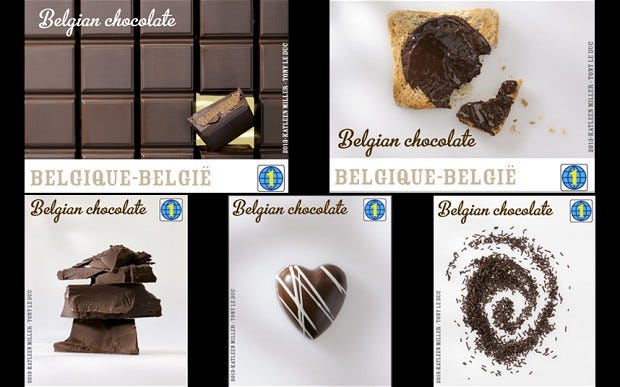
The Belgian post office (Bpost) launched a set of chocolate postage stamps that smell and taste of chocolate. The five new postage stamps depict chocolate in various forms: sprinkles, pralines, chocolate spread, pieces of raw chocolate and bars. Not only do the stamps as a whole smell of chocolate, chocolate flavoring in the form of essential cacao oils was added to the glue on the back, so that when you lick the back of the stamp, you can taste the chocolate flavor.
It is not the first time aromatic postage stamps have been issued (I covered it here and here in the past) but it would be a first that smell is augmented with flavor. [Source]
The BBC has a video explaining how the stamps are made, how they came to be and what regular people think of them. Spoiler: not great 😔, but I don’t care because I’m here to talk about chocolates. <drags soapbox out>
The most famous Belgian chocolate variety is the Belgian praline. In 1912, Jean Neuhaus Jr. (ironically a Swiss migrant) from Neuhaus Chocolates invented the praline. Before that chocolate with filling had shells that were thin because they were made by dipping the filling in chocolate. This limited the filling inside — they cannot be too liquid or too delicate or the thin shells would not be able to hold them. Neuhaus’s creation was a chocolate couverture shell that he then filled with almond paste. Today, they come in all shapes and sizes — see Guylian’s iconic sea shells.

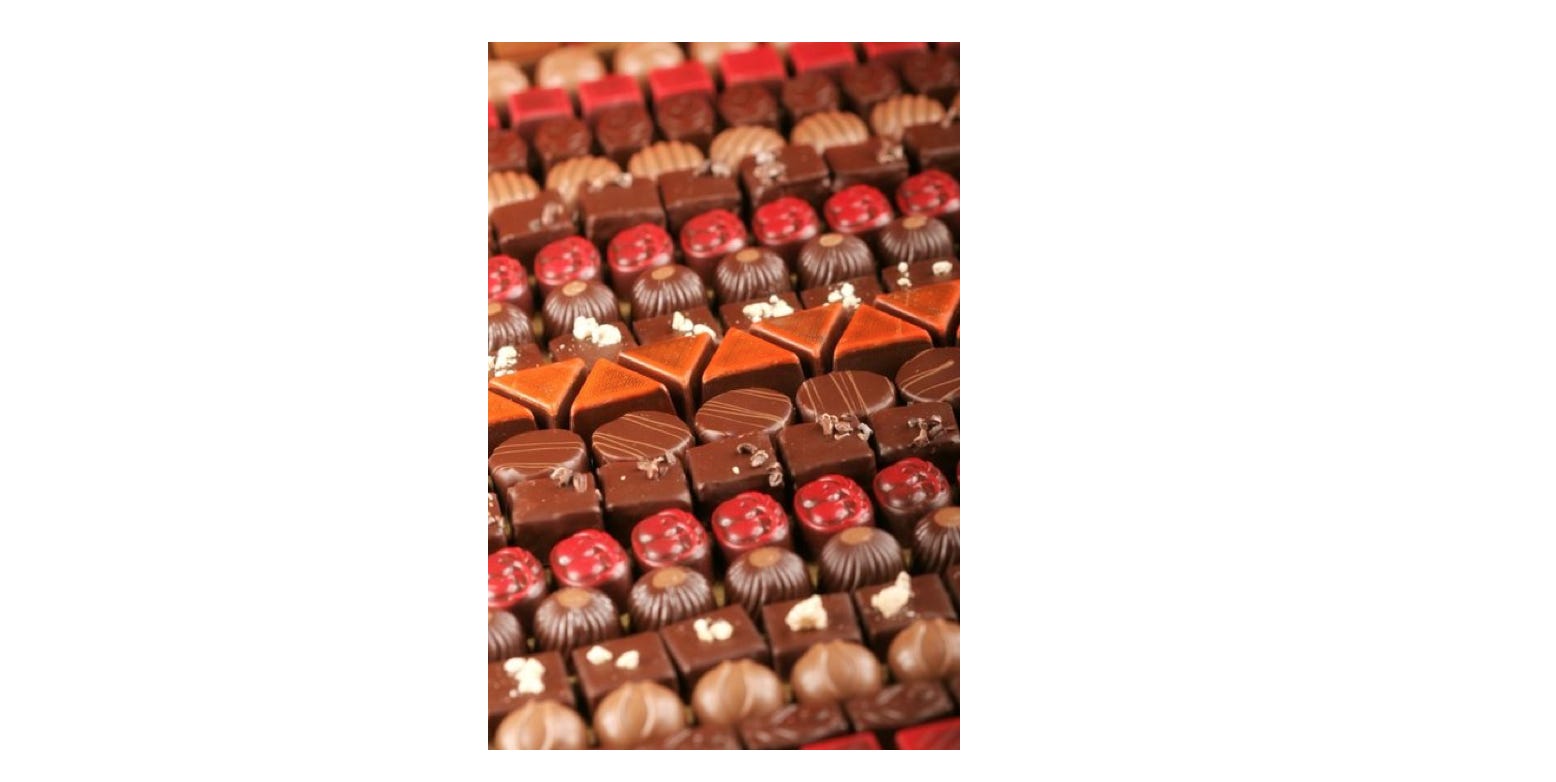
Belgian pralines [CC BY 2.0]
Will the real praline please stand up?
Wikipedia lists 3 main types of pralines: Belgian, French, and American.
Belgian pralines (pronounced pray-leen) is what the French would call a bonbon i.e. a shell-molded confection with a filling of ganache, pate de fruit, a cream, or a nut paste.
French pralines are not chocolates. Instead, it is a mixture of nuts and caramelized sugar that is ground into a paste is called a praliné (pronounced prah-li-nay in French, pray-leen in English).
American pralines (pronounced prah-leen), also not chocolates, were developed in New Orleans (also known as creole pralines). Their history is linked to French immigrants who brought the recipe to Louisiana. A creole praline looks like a cookie and is commonly made with pecans.
A Chocolate or Praline designates the product in a single mouthful size, where the amount of the chocolate component shall not be less than 25% of the total weight of the product. The product shall consist of either filled chocolate or a single or combination of the chocolates as defined under Section 2.1, with exception of chocolate a la taza, chocolate familiar a la taza and products defined in section 2.1.7.4 (chocolate para mesa) — Source: Food and Agriculture Organization of the United Nations (FAO) CXS 87-1981 Standard for Chocolate and Chocolate Products
Wonderful, now we are all up to speed, let’s go darker. <Cultural blind spot warning>
In another part of Belgium, chocolate hands (Antwerpse handjes in Dutch) are a regional specialty of Antwerp.
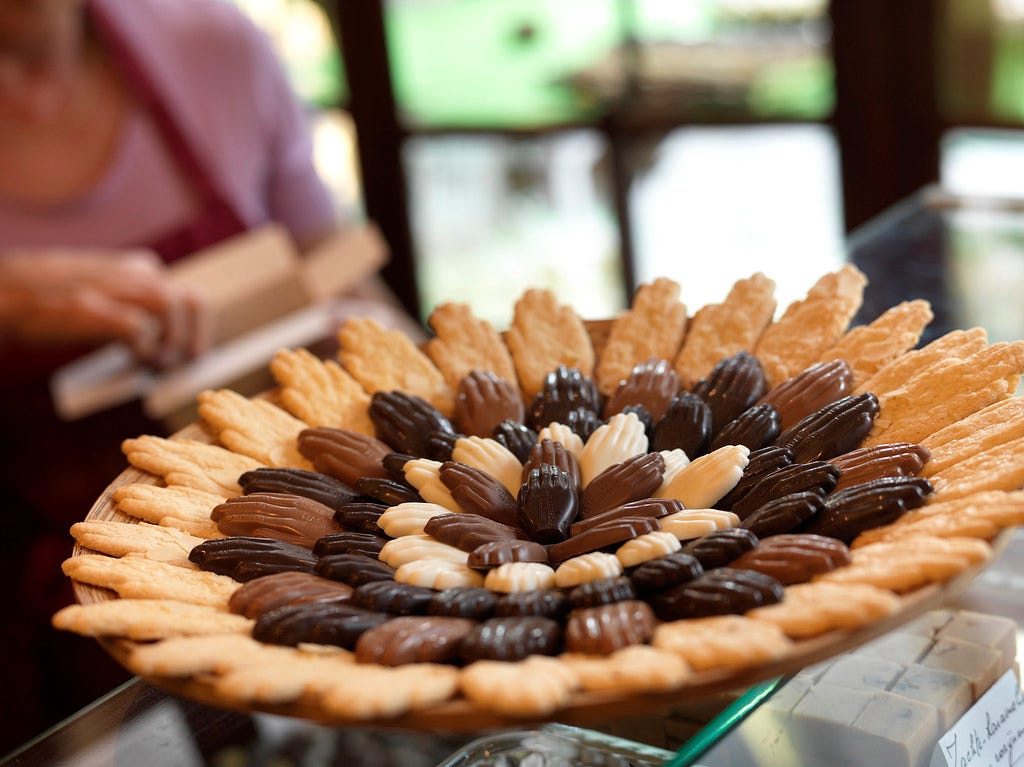
Totally not creepy. Source: Flickr
As the myth goes: Once upon a time, a giant called Druon Antigoon caused mayhem and trouble to the locals. He charged tolls for anyone wanting to cross the Scheldt river. Those who could not pay had one of their hands chopped off and dumped into the river. Then a Roman soldier named Silvius Brabo defeated the giant in battle, and in true karmic fashion chopped off the giant’s hand and threw it into the river.
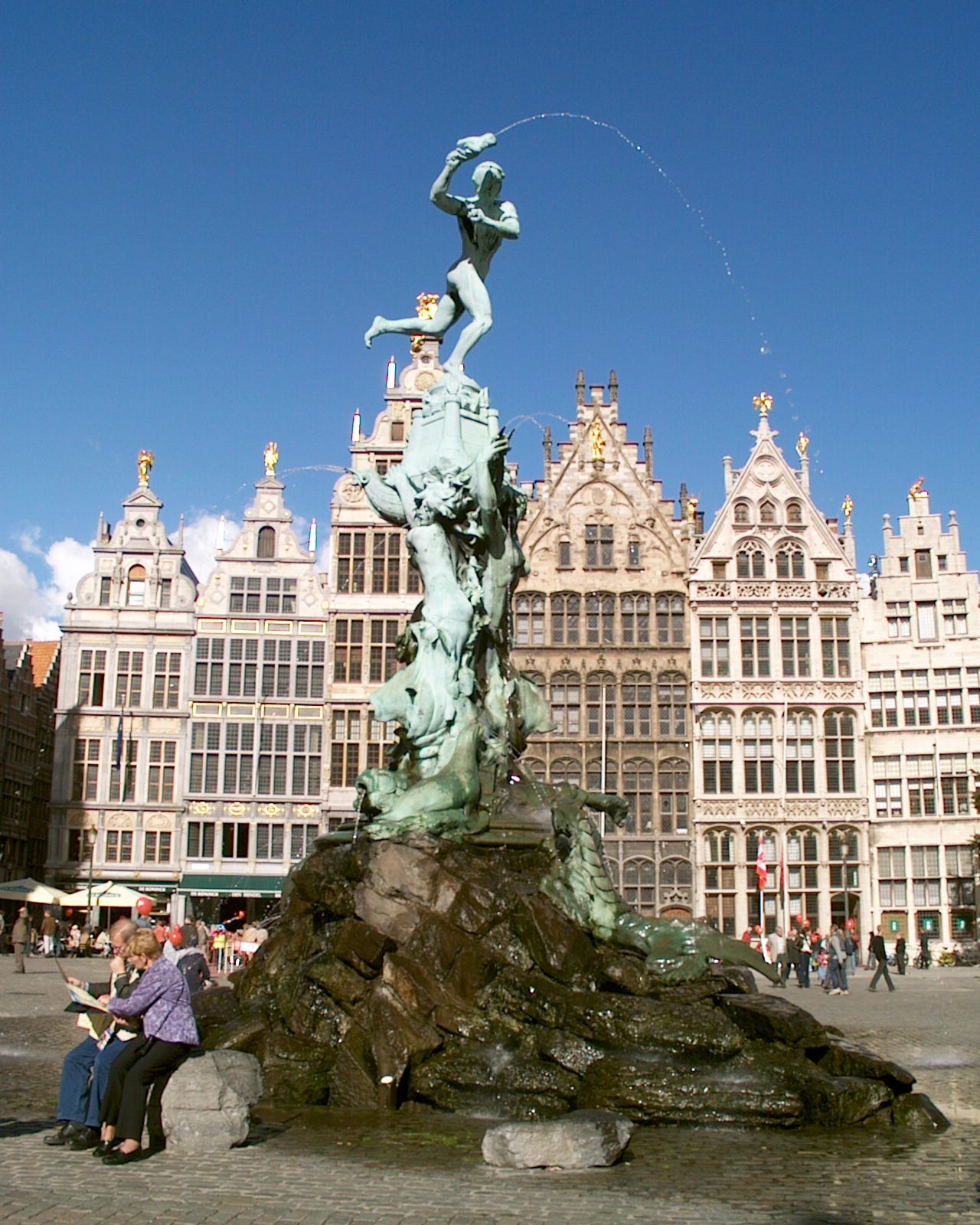
The Brabo Fountain located in the Grote Markt (Main Square) of Antwerp - G.Lanting [CC BY 3.0]
The hand chopping continues… Between 1885 to 1908, the Congo Free State was a private holding controlled by Belgium’s King Leopold II. This meant that it was ruled personally by Leopold II and not by the government of Belgium. Leopold II then majority leased it out to non-Belgian companies, mainly American companies.
Rubber was a major export for the Congo Free State and rubber collection quotas were impracticably high. So much so that failure to meet the quotas meant death.
Concerned that the soldiers were using the munitions hunting animals for sport, the officers required soldiers to show proof of one right hand for each fired cartridge. The collected hands were later smoked and preserved. One can only assume they wanted it to look presentable when showing it to the higher-ups. Don’t take my word for it, Google Images will show you lots of black and white images of hand-less Congolese. This entire episode would be labeled as the first genocide of the twentieth century.
In particular, the image that accompanies this quote is NSFL:
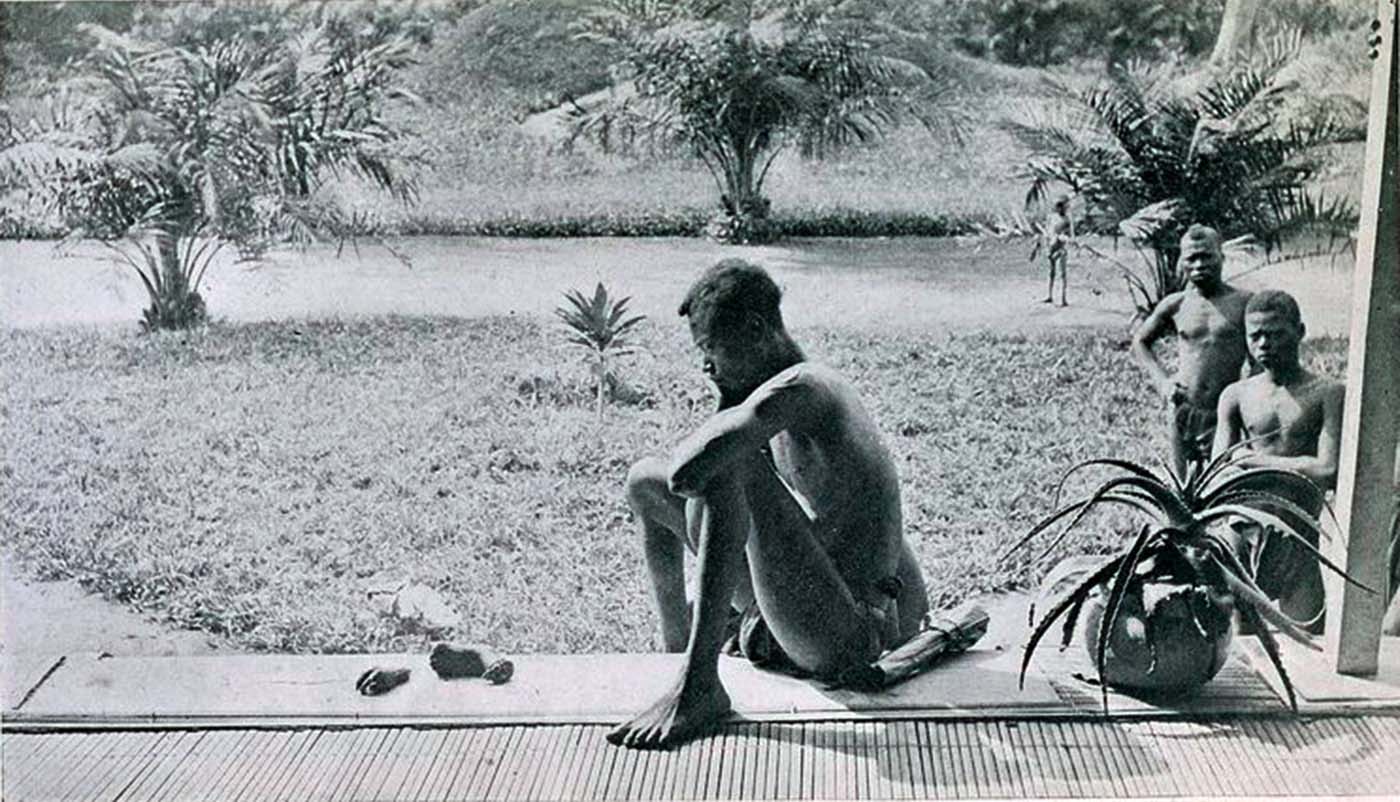
He hadn’t made his rubber quota for the day so the Belgian-appointed overseers had cut off his daughter’s hand and foot. Her name was Boali. She was five years old. Then they killed her. But they weren’t finished. Then they killed his wife too. And because that didn’t seem quite cruel enough, quite strong enough to make their case, they cannibalized both Boali and her mother. And they presented Nsala with the tokens, the leftovers from the once living body of his darling child whom he so loved. — Source: “Don’t Call Me Lady: The Journey of Lady Alice Seeley Harris”)
To wrap it up — Chocolate is delicious. Symbolism is complex. Exploitation is evil.
References
Gordan, Clay. “You Say Praline, I Say Praline, and They Say Praliné.” The New World Chocolate Society (2004)
Afshar, Ahmadreza. “The Amputated Hand of the Brabo Fountain, Antwerp, Belgium.” Journal of hand and microsurgery vol. 8,3 (2016): 178. doi:10.1055/s-0036-1593393